Lightning Temple Wizards Were Always Going to Find Each Other
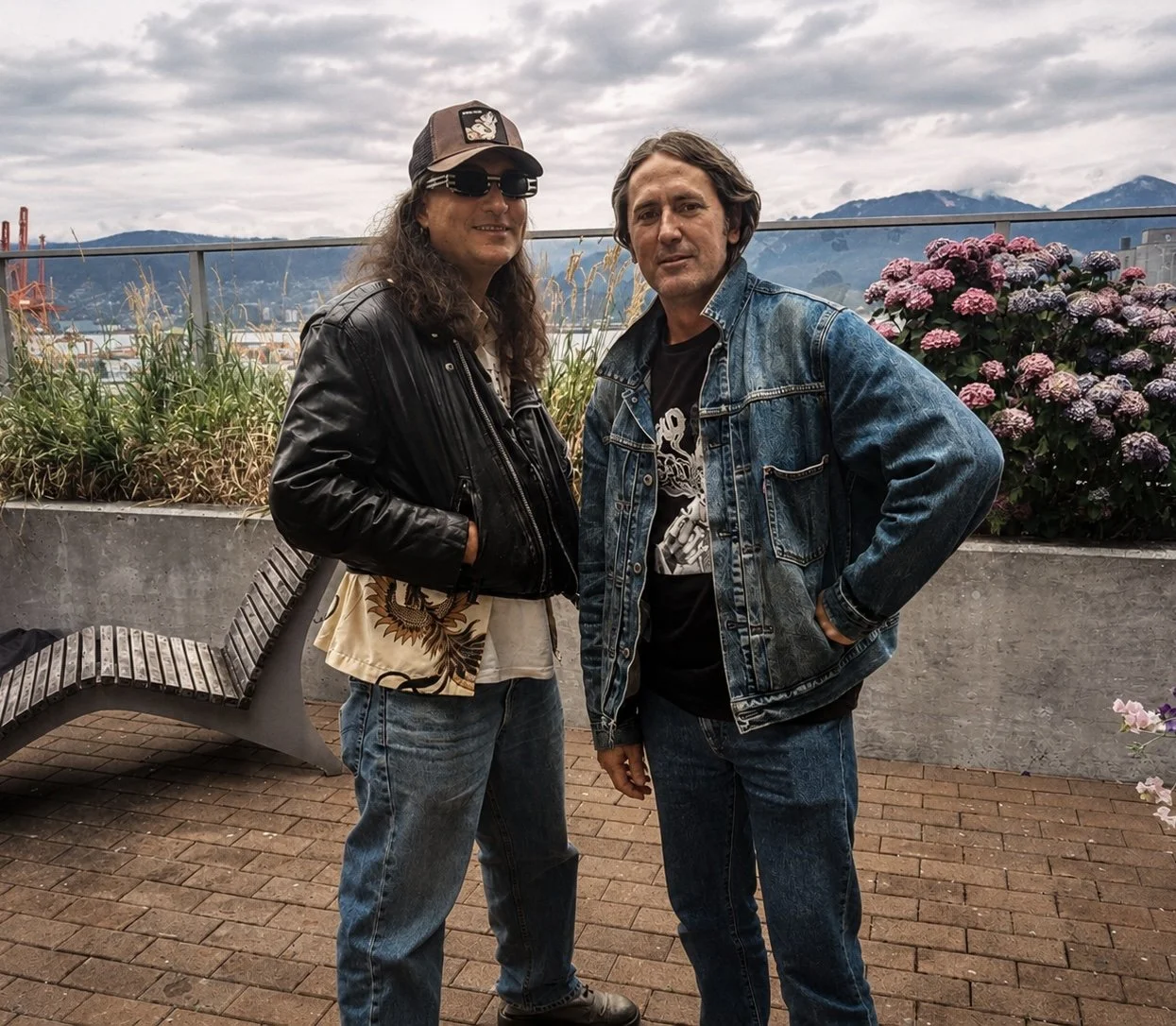
Photo and Article by Maddy Cristall
Long before Keir and Nathan started Lightning Temple Wizards, they were already very good at almost meeting each other. Somewhere around the end of the 1990s, both were at a Swervedriver show in Calgary, neither knowing the other existed. Years later, before they had met, they both went to see Dead Meadow in Vancouver and once again managed to occupy the same musical orbit without actually crossing paths. Eventually they found themselves moving through the same Vancouver music world, including the Morrissey, and the distance finally closed.
“We listened to the same kind of music way back before we knew each other,” Keir says, and the Swervedriver revelation is particularly good because it gives their history the feeling of something being rehearsed before either of them knew it. Two future bandmates were somewhere in the same Calgary crowd roughly a quarter-century ago, presumably paying more attention to the guitars than to the stranger who would eventually become a collaborator. Discovering later that they had repeated the trick with Dead Meadow only made it funnier.
By the time they actually met, neither needed someone else to provide him with songs or a musical identity. Keir and Nathan had both spent years writing independently and arrived with catalogues of their own, which remains essential to understanding how Lightning Temple Wizards works. There was never one principal songwriter recruiting musicians to realize a finished vision; there were two people with a lot of songs discovering what happened when those songs were placed in the same room.
Keir had already travelled a long musical road. He played saxophone in bands during the 2000s, and when those projects ended he spent years working primarily as a solo singer-songwriter with guitar and voice. Becoming a stronger guitarist was a deliberate project, but playing alone also meant having to carry the entire architecture of a song himself. Once he was playing with Nathan and, eventually, a rhythm section, that architecture could open up. Guitar parts could wander, instrumental sections could stretch and songs no longer had to behave like something one person could reproduce alone.
Nathan arrived with his own backlog and a musical appetite that had broadened considerably over the years. He describes his current philosophy as essentially “no limitations, no borders, no boundaries,” which is a useful way into a band that becomes difficult to categorize almost as soon as you try. Time in Louisiana had opened him to older country traditions, particularly figures such as Johnny Cash and Hank Williams and the places where country, blues and rock overlap. He is not interested in reproducing those sounds so much as what survives underneath them: the strength of the song itself.
Keir approaches music from his own direction, but he is similarly uninterested in policing genre. Between the two of them, Lightning Temple Wizards can move through psych, punk, metal, grunge, alternative rock and post-rock without behaving as though any of those labels should dictate what happens next. That was my experience with Dreamland. On first contact it sounded like a psych-rock record, but the longer I listened, the less useful that description became.
Psych rock, after all, can become as formulaic as anything else. A genre supposedly devoted to expanded consciousness can eventually produce its own checklist: reverb, haze, repetition, transcendence. Lightning Temple Wizards seem happier keeping whatever elements they like and discarding the obligation to stay inside the category.
The reason the music moves around so freely becomes clearer when Keir and Nathan explain how the songs actually enter the band. There is no ambiguity about authorship: one of them writes the original song and brings it in. Collaboration happens after that. The interesting part is watching what the song becomes once another musician starts responding to it.
“We both have tons of songs,” Nathan says. “We both write a ton of songs.”
That may be Lightning Temple Wizards' greatest resource and its central logistical problem. There is always more material. A song might arrive with its basic guitar, vocal, structure and identity already established, but once the other musicians begin finding their parts, it starts absorbing different instincts. The original songwriter remains clear, while the arrangement becomes increasingly communal.
Their first attempts to figure out what that relationship could become happened at the Jamnasium on Clark Drive, a now-gone hourly rehearsal space whose décor sounds as though it had been waiting for a band called Lightning Temple Wizards. Keir and Nathan remember naked figures on the walls, paintings of men with multiple eyes and assorted psychedelic oddities. If somebody were designing a fictional rehearsal room for this band, they might have been told to make it a little less obvious.
Those sessions were not the arrival of a fully formed band so much as two musicians testing the possibilities. They played their songs, talked, rehearsed and slowly worked out what happened when their separate musical histories started interacting. There was no mythology attached to it and, listening to them reconstruct the period together, that absence of mythology feels appropriate. The story is mostly rooms, songs, people coming and going and the gradual recognition that there was something worth continuing.
The Twelve Kings became another important part of that process. At an open jam they remember as “Jams in the Key of Green,” much of the backline was already there and musicians arrived with guitars, basses, saxophones and whatever else they intended to contribute. Temporary bands assembled themselves, sometimes playing recognizable songs and sometimes heading considerably further out. Keir and Nathan began bringing original material into that environment as a loose duo and picking up drummers as they went. Chuck became a recurring presence and also filmed the jams for online broadcast.
Keir describes those nights as the “kernel” of Lightning Temple Wizards. The band had not yet become the thing it is now, but the songs were leaving the private space between two writers and beginning to interact with other musicians and audiences. Their proper debut followed at the Princeton, while the rhythm section continued to evolve: Mike was on drums, then Chuck, then Blake and now Daniel. For a long time the constant was simply Keir and Nathan, continuing to bring songs into the project while the shape around them changed.
By the time Blake was playing with them, there was enough material for an album, and the logic behind recording it seems to have been characteristically uncomplicated: they had the songs, so they might as well make the record.
The resulting session is one of those stories that says almost as much about a band as the record itself. Lightning Temple Wizards went into the studio and recorded the core tracks for roughly thirteen songs in about eight hours. There was no leisurely week of staring at amplifiers or debating snare sounds because Blake needed to get back toward the Sunshine Coast and had a ferry to catch.
It is a wonderfully Canadian logistical constraint on a rock record. Somewhere in the middle of recording most of an album, BC Ferries had effectively become part of the production schedule.
The speed, however, should not be confused with carelessness. They had spent weeks and months rehearsing the material, which was precisely why they could move through it so quickly. The image that remains is very Lightning Temple Wizards: a large pile of songs, a limited amount of time, everybody knowing what they need to do and someone eventually glancing at a clock because there is a ferry involved.
Dreamland makes more sense once you know that story and understand how Keir and Nathan think about composition. Its identity does not depend on every track receiving the same sonic haircut. Melody can coexist with fuzz, a psychedelic song can wander toward something heavier or stranger, and one composition can contain a nod toward Stone Temple Pilots because that happens to be where the idea wanted to go. The connective tissue is not strict genre consistency but two songwriters who enjoy seeing what can be done to a song without destroying what made it a song in the first place.
Their instrumental backgrounds help make that exchange fluid. Nathan considers bass his natural instrument even though his guitar playing has developed considerably over the years. Keir is primarily a guitarist in Lightning Temple Wizards but comes to it through saxophone, solo performance and years of having to think about how a composition works when there is nobody else underneath it.
Then there is what might politely be called Keir's compositional weirdness. Some of his arrangements do not map neatly onto the expectations another musician might bring into the room. A section can repeat an unexpected number of times, a riff can appear briefly and disappear, and the internal mathematics can refuse to behave in the most obvious way. Nathan talks about this with affection rather than frustration, partly because years of playing with very different musicians have made him comfortable adapting in real time.
“I don't want him to change at all,” Nathan says.
That comment gets at something important about their relationship. The collaboration is not a process of sanding away whatever is unusual about the other person's writing until both songwriters sound alike. If anything, the peculiarities are useful. Each brings a complete musical instinct and catalogue into the room, and then the other has to respond to it. Lightning Temple Wizards exists somewhere in that exchange.
It also explains how Johnny Cash and Dead Meadow can both function as meaningful reference points without the result feeling contradictory. Cash represents one kind of durability: a song with enough melodic and structural strength to survive radically different treatments. Dead Meadow suggests another possibility, where repetition, volume and atmosphere can open a composition outward until the song becomes a place musicians can wander around inside. Lightning Temple Wizards want both. They want songs with bones, but they also want to find out how far those bones can bend.
That impulse has become even more apparent with Daniel on drums. Keir and Nathan estimate that five or six newer songs have already been rehearsed enough by the three of them to contemplate bringing them to the stage, while still more material waits behind those. Having access to a lockout space near Commercial and Hastings has also changed the practical rhythm of the band. Instead of negotiating every rehearsal against an hourly-room clock, they have more opportunity to sit inside the material and let it develop.
The process is straightforward until it isn't. Keir or Nathan brings in an original song, the band plays it repeatedly, everyone finds a part and they continue until the arrangement feels sturdy enough that nobody is dropping anything essential. Keir sometimes gives himself an additional problem because his songs can be wordy; one newer composition required extra homework when he discovered that remembering all of the lyrics while simultaneously navigating the arrangement was becoming its own challenge.
Once a song becomes secure, however, the band becomes increasingly interested in making it insecure again.
Improvisation is taking up more space in Lightning Temple Wizards' live identity, with some newer material stretching toward six or seven minutes and leaving room for longer instrumental passages. “Monster Monster” has become particularly useful near the end of a set because the composed song can finish after three or four minutes and the band simply chooses not to stop. The ending can continue for another three, four or five minutes depending on what happens in the room.
Keir and Nathan both love King Gizzard & the Lizard Wizard, while Dead Meadow remains an obvious point of shared affection, but what they describe is not jamming simply because nobody knows how to end a song. The attraction is almost the opposite. They want the written composition to be solid enough that everyone knows where it is, because that security gives them permission to start pulling it apart.
They call the result “more deadly.”
It is a good phrase, particularly because neither Keir nor Nathan seems interested in treating the band with the solemnity that often attaches itself to discussions of experimental music. They care deeply about the songs and can talk at length about how they are constructed, but their friendship comes through just as strongly in the interruptions, corrections, jokes and half-remembered details that surface while they reconstruct the band's history.
They have no mythology, and they do not seem to want one. Even the coincidences that preceded the band are treated as funny discoveries rather than evidence of cosmic design. They both went to Swervedriver. They both went to Dead Meadow. They kept liking the same kinds of things before they knew the other person existed, and eventually the radius became small enough that they met.
Vancouver matters to that story because Lightning Temple Wizards' history can almost be mapped through the rooms that allowed it to happen: the Morrissey, the Jamnasium, the Twelve Kings, the Princeton and rehearsal spaces around Commercial and Hastings. Some of those places disappear, some change and others take their place, but bands like this are built in precisely those unremarkable moments when musicians are able to rehearse, jam, encounter one another and play before anyone knows what the project is going to become.
In that sense, Lightning Temple Wizards could never have been assembled according to a plan. You would have needed Keir and Nathan to develop separately as songwriters, put them at a Swervedriver show without introducing them, repeat the experiment years later with Dead Meadow, let them pass through other musical projects and then eventually put them in the same Vancouver orbit. After that you would need a Clark Drive rehearsal room decorated like a minor psychedelic emergency, communal jams at the Twelve Kings, a changing cast of drummers and enough time for two enormous catalogues of songs to start colliding.
Somehow, that is more or less what happened.
Now there is already talk of another album, perhaps with a single first, while the songs continue to accumulate and the live arrangements become increasingly elastic. Keir has been handling much of the unglamorous business of emailing venues and trying to arrange shows, while Nathan readily admits that scheduling is not where his particular genius lies. Yet practical goals do not seem to be the thing keeping either of them there.
Near the end of our conversation, I ask Keir whether rehearsing is primarily fun or whether each session needs to point toward something concrete, whether a show, a recording or another finished piece of work. His answer starts there and then moves somewhere much closer to the reason the band exists.
“The process of doing it is the reason for doing it,” he says. “You wanna be inside of the music as an artist as much as you can and as often as you can. That's the point of it.”
It is difficult to come up with a better description of Lightning Temple Wizards than that. Keir spent years writing and playing because he wanted to be inside the music, while Nathan kept writing, performing and absorbing sounds until the old boundaries between genres became increasingly irrelevant. When they finally met, neither needed the other to supply songs, ambition or identity. Instead, each found another person with an excess of material and enough curiosity to see what happened when those separate bodies of work collided.
The result is a band where Johnny Cash can coexist with Swervedriver, Dead Meadow can share conversational space with Stone Temple Pilots and King Gizzard, and a tightly written three- or four-minute song can earn the right to mutate into something much longer onstage. The original songwriter remains identifiable, but collaboration begins as soon as the song enters the room, and the more confident the band becomes in the material, the more willing they are to pull it apart and discover something new inside it.
Maybe Keir and Nathan were always going to find each other, although that explanation probably gives fate too much credit. The less romantic and perhaps more appropriate explanation is that they kept showing up. They kept going to shows, kept writing songs, kept entering rehearsal rooms and jams and kept remaining curious about music long enough for two parallel paths to finally cross.
Now that they have, Lightning Temple Wizards seem less interested in deciding exactly what the collision should be called than in staying inside it for as long as possible.
Listen to the band here