The World According to Paul Snider Is One Giant Instrument
By Johnny Kosmos
The Vancouver composer behind Orchestra of Sound has spent years turning the overlooked sounds of ordinary life into cinematic music. His new single, “The Sounds of Canada,” is out now, while his forthcoming album, Flying High, is slated for release November 1.
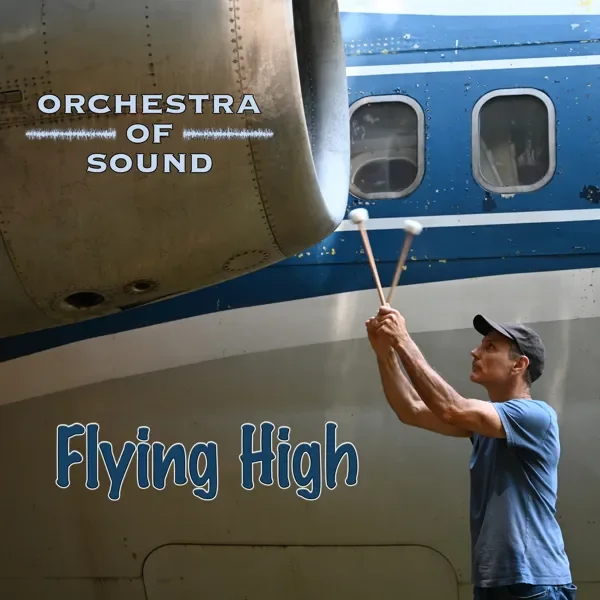
Most musicians looking for the right percussion sound would start in a studio, where between acoustic instruments, electronics and a near-infinite library of samples, almost anything can be summoned on command. Paul Snider took a more complicated route. While working on “Flying High,” the Vancouver musician, composer, filmmaker and actor decided he wanted percussion played on an actual jet airplane, a search that eventually brought him to Oregon, where a man had converted an old Boeing 737 into his home. Paul got permission to record the aircraft, and the resonant casing of one of its turbines found its way into the track.
There are other sounds buried in the composition, including industrial machinery, an approaching train, abandoned cars recorded in a Canadian junkyard and an old pot from the century-old German farmhouse where Paul’s father-in-law grew up. It is an unusual palette, certainly, but reducing Orchestra of Sound to the novelty of its ingredients misses what Paul is doing with them. He is interested in timbre, resonance and the musical character an object acquires once it has been removed from its original context, tuned, layered and given a different job to do.
That distinction becomes particularly clear on Paul’s new single, “The Sounds of Canada,” which is out now and draws from recordings he gathered while travelling across the country in an electric vehicle. Beginning with a piano theme, he built the piece outward using sounds collected from coast to coast, including Rocky Mountain rocks, Prairie wheat fields and East Coast lobster traps, folding them into an instrumental arrangement in which geography becomes part of the orchestration.
Listen to “The Sounds of Canada” here.
What makes the track work is that you do not need the field notes to appreciate it. Knowing where the sounds came from changes the way you listen, and there is pleasure in trying to pick apart the architecture of the recording, but “The Sounds of Canada” does not depend on its backstory. Paul has enough musical instinct to let the source material serve the composition rather than the other way around, using those recordings for their tonal and rhythmic qualities instead of displaying them as curiosities. The result is a beautifully textured piece and a compelling representation of the depth and individuality of his talent, particularly his ability to find musicality in sounds most of us have trained ourselves not to notice.
There is also something appealingly old-school about that approach, despite all the technology required to execute it. Musicians have always chased sounds that were not supposed to be musical, whether through prepared instruments, tape manipulation, found percussion, sampling or simply pushing conventional instruments past their intended limits. Paul belongs somewhere in that lineage, although his particular version involves physically going out into the world and collecting the raw material himself. The field recording is only the beginning; what matters is what happens when he gets it home.
That way of working can be traced back to 2010, when Paul was volunteering at a rural school in western Kenya and teaching music to approximately 30 children in a mud-walled schoolhouse. One afternoon, the students began tapping rhythms on their old wooden desks, and the room amplified the lower frequencies until those battered pieces of classroom furniture took on a surprisingly rich resonance. Paul left the experience wondering whether an entire orchestra could be created from ordinary objects, a question that would occupy him for much of the next decade.
He began experimenting with instruments made from reclaimed and recycled materials, eventually premiering Junk! The Musical at the Vancouver Fringe Festival in 2014. That concept evolved into The Music of Junk, a concert-style theatrical production featuring an orchestra of performers playing instruments Paul had designed and built himself, which toured theatres in British Columbia through 2018. Later came Street Beats Musical Installation, a public installation constructed from reclaimed materials that invited other people to discover the musical possibilities of the objects for themselves.
During the pandemic, Paul began thinking about the concept differently. Rather than hauling an orchestra of invented instruments onto a stage, he wondered what would happen if he assembled one from recordings instead, using the world outside the studio as his instrument cabinet. In 2021, he and his wife set out across Canada and back in an electric car, with Paul recording bridges, metal structures, oil drums, benches and whatever else offered an interesting resonance along the way. Subsequent trips expanded the collection internationally, leaving him with an increasingly deep archive of sounds from which to compose.
The method that emerged is part traditional songwriting and part sonic archaeology. Paul often begins at the piano, although melodies also arrive while he is walking, driving or travelling, in which case he sings them into his phone and sorts them out later. Once a composition begins taking shape, he searches his field recordings for sounds that can occupy particular musical roles, cleaning, tuning and arranging them until an object that once belonged to a junkyard, a bridge or a landscape becomes percussion, melody or texture. Some compositions contain 40 to 60 individual sounds, enough that the finished recording bears little resemblance to the collection of noises from which it began.
In retrospect, Paul was probably headed toward this collision of music and technology long before he had a name for it. He grew up with a musical mother and an inventive father who built electronics that did not yet exist, learned popular songs by ear on his mother’s Hammond organ in the 1970s, played keyboards in rock bands in high school and eventually studied Joint Honours Computer Science and Music at the University of Waterloo. Those two disciplines might once have looked like competing interests, but in Orchestra of Sound, they sound more like two sides of the same education.
His career took a similarly indirect route. After university, Paul worked in software while continuing with music and theatre, then moved to Vancouver in 1997 to become a partner in a 28-person technology startup that eventually grew to approximately 450 people and became one of British Columbia’s fastest-growing technology companies. He was named one of Business in Vancouver’s Top 40 Under 40, but by 2009 he was ready to leave the software business and pursue entertainment full time, founding Born To Fly Entertainment and moving deeper into the work that had been running alongside his technology career all along.
What followed was eclectic even by multidisciplinary standards. Paul wrote the sung-through musical The Curtain, a love story set against the fall of the Berlin Wall, and produced a full-cast recording; he wrote, produced, directed, scored and starred in the feature film Everywhere But Here; and he created multiple short films while accumulating appearances across more than 90 film, television and theatre productions. In 2013, he released an award-winning music video for his folk-rock song “Better Than Me,” followed by a folk-rock album in 2018. Rather than reading as unrelated detours, those experiences make Orchestra of Sound easier to understand, particularly its combination of composition, visual storytelling, performance and technology.
The project eventually became a one-man multimedia stage show, with Paul performing the music alongside projected footage revealing where its component sounds came from. Before performing a composition, he can let the audience hear some of those sounds in their original form, effectively exposing the bones of the arrangement before putting the music back together. It is a smart theatrical device because it changes the way an audience listens: once you know what an apparently orchestral texture looked and sounded like in the wild, you begin listening for the transformation.
The show premiered at the Vancouver Fringe Festival in 2023 and was presented at the Nest Theatre on Granville Island in 2024 before travelling to the Edinburgh Festival Fringe later that year, where Paul performed 21 shows in 24 days. Following Edinburgh, he returned to the studio to expand and reimagine the compositions as an album, shifting material developed partly as a visual and theatrical experience into recordings that would have to work entirely on their own terms.
Now that long-running experiment is moving to the foreground. Flying High, Paul’s new instrumental album, is slated for release November 1, 2026, with Vancouver-based mastering engineer, composer and producer Kurt Von Hahn handling the mastering. The album draws on sounds captured across Canada and beyond, bringing years of field recording, composition, travel and instrument building together in a format where the music can exist independently of the stage show that preceded it.
With “The Sounds of Canada” out now, listeners do not have to wait until November to hear where Paul has taken the idea. The single offers a particularly fitting entry point into Flying High, not because Rocky Mountain rocks, Prairie wheat fields and East Coast lobster traps make for a good story, although they certainly do, but because somewhere in the process Paul manages to make you forget that you are listening to unlikely objects at all.
After years of building instruments, collecting sounds and following musical ideas into places where most composers would have little reason to go, Paul has arrived at a deceptively simple proposition: the world is already full of instruments, provided somebody is listening closely enough to hear them.