
LA BOLA NEGRA: An Odyssey for the Queer World
By JV Corrêa
This powerful film is making its highly anticipated premiere at the Toronto International Film Festival, where it has quickly emerged as one of the festival’s most talked-about and sought-after screenings. With strong audience interest and buzz building throughout TIFF, it’s also shaping up as a notable contender for the coveted People’s Choice Award, which will be announced this Sunday, September 20- Learn More Here
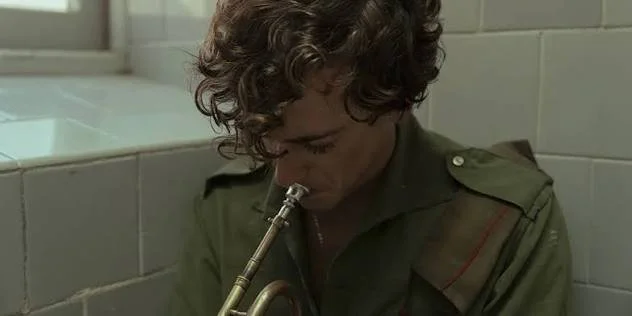
What starts as a traditional war film slowly turns into an epic homage to the queer experience across generations: raw and sensitive, composed of dimensional emotional landscapes and delivered with the steady-hand precision of those holding the gun.
Three queer lives are separated by different eras of war, each physical in its capacity to wound and deeply emotional in its consequences. Together, they form a translation of queer experience across history that resounds and ricochets with the force of the fascist regimes that once tried to suppress it. Yet La Bola Negra remains defiant, weaving itself into the psyche of men forced into hiding across generations.
Its soundtrack echoes through the mental chambers of those who cannot hear it and those who can dance along, becoming a tribute to queer resilience and desires that linger long after the film ends. There is an ambition and sweep here that feels inseparable from the tradition of Spanish cinema the film so clearly wants to honour.
The Javis choose to fully immerse us in the lives and thoughts of these multigenerational characters, threading together a mosaic of queer experience that is loud in the silence, raw in its ambiguity and aggressive in the glide of the camera. Across land and sea, through bird’s-eye views of corpses and wounded hearts sharing the backs of war-torn trucks, we are invited to account for every drop of blood streaming through these poetic images, histories and faces, until the personal and political become impossible to separate.
Poetic justice could never do justice to the trauma that shaped these characters. This is an odyssey for the queer world, and The Javis achieve a kind of queer excellence that does not ask permission, perhaps in a way Lorca himself might have recognized.
The male body and the male gaze are beautifully treated and immortalized in the image of a falling, arrow-wounded statue amid the debris. Again and again, we are invited to consider the power of choice amid the chaos of war and destruction, even when no real choice exists beyond obedience as a means of survival. We cannot judge these characters from the safety of another time. We can only bear witness to the conditions that shaped them.
In a Spanish world painted with the rigid colours of fascism, queer joy emerges from the wreckage that once held lives down, persistent as evergreens. Survival was never an option so much as a demand carried from one generation to the next.
The genius of the writing becomes apparent when pain is expressed through assertive wide shots of buildings and landscapes that seem to hold more emotion than any soldier’s clothes ever could. The environments themselves become weighted by history. Geography remembers what people are forced to forget.
As an exercise in correcting queer history, La Bola Negra may also be an exercise in relishing the loves that could never exist in equal measure. There is something to be said for honouring that history without the chains of must-dos and boxes that must be checked. This is where creativity thrives and bleeds all over the paper: when invisible emotional currents guide the filmmaking rather than the other way around, and structure is allowed to bend in service of a riveting delivery. La Bola Negra does just that.
The tenderness, rawness and absolute sensual mechanics of the Spanish language become a cinematic device, unlocking the equally tender, raw and sensual consciousness of these characters. The English subtitles can never quite do justice to the complex, articulated rhythm of the language and everything carried inside it. Language here is not simply how these characters communicate. It is part of how they desire, conceal, survive and remember.
Each of these characters carries the solitude and restlessness of facing choices so deeply tied to Spanish history that the film becomes social commentary without surrendering its intimacy. We are made to feel the impossible choices of war and the consequences of sitting in disquiet without resolution, when every available path forward carries its own kind of loss.
Through a sensibility that repeatedly evokes Lorca, we encounter loss, grief, devastation and pain, and somehow come to understand that the human condition can force us to destroy parts of ourselves in order to construct imagined, possible futures. Death itself becomes political because it can never be entirely isolated from the structures of repression and survival that produced it.
And still, we survive.
In others. In future generations. In the spirit of collectiveness and in the infinite expanse of the queer universe. We have a place to stand, a past to look back to and a collective voice capable of carrying us forward, even when history has tried to erase the evidence that we were ever there.
No human war can tear apart queer consciousness. We have learned how to survive chaos, instability, abuse and the violence of being defined by others, one of the enduring paradoxes of inhabiting a queer body across generations. We are taught to let others define our movements, gestures and postures, turning social performance into a survival device, because queer bodies have so rarely been allowed simply to exist without being watched, judged or translated by someone else.
La Bola Negra ultimately becomes a poetic renaissance: a reminder that we queers have always existed within the forces that reshape society, even when history has attempted to write us out of them. Reclaiming our stories means refusing to leave them buried beneath the histories that tried to erase us.
The Javis do not simply recover those stories.
They return them to us alive, defiant and burning brightly enough that no one can pretend not to see them.
Like a bola negra against a white blanket of snow in Lorca’s world.